From Beggar to Emperor
The Ming dynasty's founder, Zhu Yuanzhang, had about as unlikely a background as any Chinese emperor: orphaned young, he spent time as a wandering Buddhist monk and beggar before joining the Red Turban rebels fighting against Yuan Mongol rule. He rose to lead the rebellion, defeated his rivals, and in 1368 founded the Ming dynasty, taking the reign name Hongwu. His rule was marked by efforts to restore Chinese institutions after a century of Mongol governance — and also by extreme paranoia, including purges of officials he suspected of disloyalty.
The Forbidden City Rises
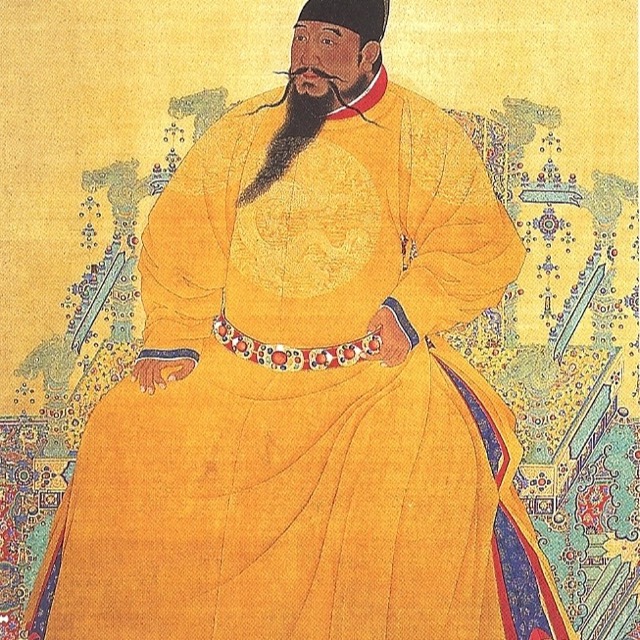
Hongwu's son, the Yongle Emperor (shown here), seized the throne from his nephew and moved the capital from Nanjing to Beijing — a decision that required building an entirely new imperial complex. The result was the Forbidden City, a vast palace complex of nearly 1,000 buildings that would serve as the residence and ceremonial center of Chinese emperors for the next five centuries, through both the Ming and Qing dynasties. Its scale and symbolism were a deliberate statement: this was the literal center of the world, as far as the Ming court was concerned.
Treasure Fleets and Porcelain
The Yongle Emperor also sponsored one of the most remarkable maritime projects in pre-modern history: the voyages of Admiral Zheng He, whose treasure fleets — some ships reportedly over 100 meters long — sailed as far as Southeast Asia, India, the Arabian Peninsula, and the east coast of Africa, decades before European Age of Discovery voyages. Later Ming rulers turned inward and scaled back these expeditions, but the dynasty remained an economic powerhouse, exporting enormous quantities of the blue-and-white porcelain that became (and remains) globally synonymous with "China." The dynasty eventually fell in 1644, weakened by financial strain, peasant rebellions, and external pressure from the Manchus, who would found the Qing.
The Forbidden City built under the Ming remained the seat of power for the Qing dynasty that followed — meaning the palace settings in most Qing-era costume dramas are, technically, Ming architecture.
From the Forbidden City to China's last dynasty
See the full timeline, or jump ahead to the Qing dynasty that inherited the Forbidden City.