One Ruler, Seven Kingdoms
By the end of the Warring States period, China wasn't really "China" — it was seven rival kingdoms that had been fighting each other for centuries. The state of Qin, in the northwest, had built a military machine around Legalist philosophy: strict laws, harsh punishments, and rewards based purely on merit and results rather than birth. Between 230 and 221 BCE, Qin conquered the other six kingdoms one by one. Its king, Ying Zheng, declared himself Qin Shi Huang — "First Emperor of Qin" — and the country's modern English name, China, likely traces back to "Qin" itself.
Standardizing an Empire
Conquest was the easy part; holding the empire together was the real achievement. Qin Shi Huang standardized the script so officials everywhere could read the same documents, unified currency and weights and measures, and even set a single axle width for carts so that wheel ruts on the empire's new road network would match everywhere. Regional fortifications along the northern frontier were connected and extended into the first version of what would become the Great Wall.
None of this was gentle. Forced labor on these projects, book burnings aimed at rival philosophies, and the execution of dissenting scholars are central to the Qin's reputation for brutality. The Legalist system that made Qin so effective at conquest made it deeply unpopular as a government.
An Army for the Afterlife
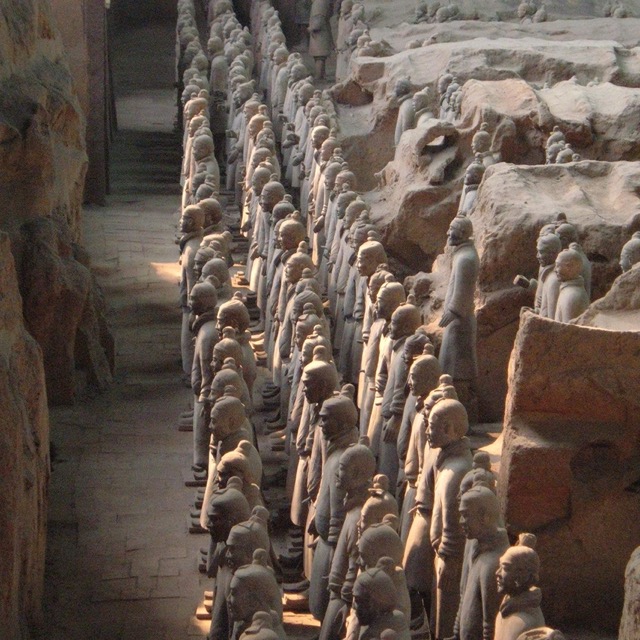
Qin Shi Huang was obsessed with immortality — he sent expeditions in search of elixirs of eternal life — and prepared an extraordinary backup plan: an underground necropolis near modern Xi'an, guarded by an army of over 8,000 life-sized terracotta soldiers, horses, and chariots, each with individualized faces. Buried and forgotten for over two thousand years, the Terracotta Army was rediscovered by farmers digging a well in 1974 and is now one of the most famous archaeological sites in the world.
Collapse — and a Lasting Template
Qin Shi Huang died in 210 BCE, and the dynasty he built collapsed within four years — rebellions broke out almost immediately, exhausted by decades of forced labor and harsh law. But the idea he proved — that China could be a single, centrally administered empire rather than a patchwork of feudal states — outlived the dynasty by two thousand years. Every dynasty that followed, starting with the Han, kept the basic shape of the centralized empire while quietly abandoning Qin's harshest methods.
This is the era dramatized in Treasure Venture (寻秦记), where a modern soldier is thrown back into the Warring States period and finds himself standing next to the boy who will become Qin Shi Huang — a fictional spin on the unification story above.
From unification to golden age
See the full timeline, or jump to the dynasty that followed Qin's collapse.