The Xia (c. 2070–1600 BCE): Where History Meets Legend
The Xia is China's first dynasty according to traditional histories, credited to a founder named Yu the Great — famous in legend for taming a catastrophic flood. For centuries the Xia was treated as semi-mythical, but archaeological work at sites like Erlitou in Henan has uncovered palace foundations, bronze workshops, and urban planning consistent with the Xia's traditional dates. Whether "Erlitou culture" and "Xia dynasty" are the same thing is still debated, but the site shows that organized, hierarchical society in the Yellow River valley is older than once assumed.
The Shang (c. 1600–1046 BCE): Bronze and the Written Word
The Shang is where Chinese history becomes unambiguously documented. At Anyang, archaeologists found tens of thousands of "oracle bones" — ox scapulae and turtle shells inscribed with questions for the royal ancestors, then cracked with heat to divine the answer. The inscriptions are the earliest confirmed form of Chinese writing, and many of the characters are recognizable ancestors of characters used today.
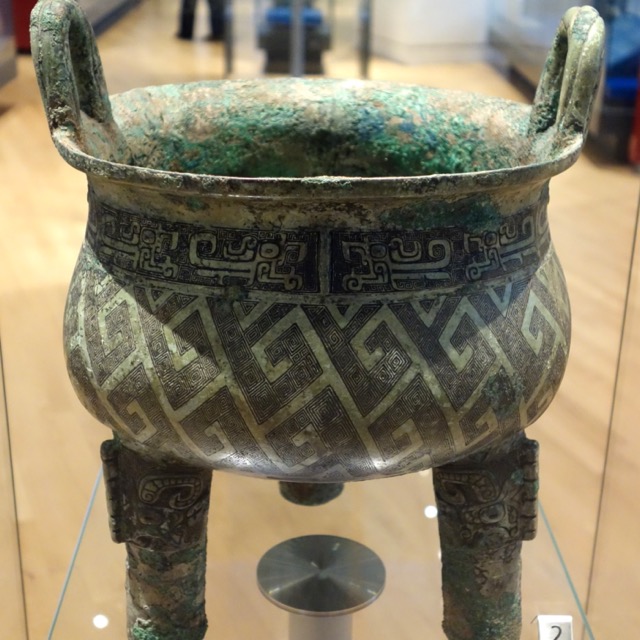
The Shang are equally famous for bronze casting. Enormous ritual vessels like the ding shown above were cast using piece-mold techniques of remarkable sophistication, used in ceremonies to communicate with royal ancestors — a reminder that, in Shang China, politics and religion were the same activity.
The Zhou (1046–256 BCE): The Mandate of Heaven
The Zhou overthrew the Shang and ruled — at least nominally — for nearly 800 years, making it the longest dynasty in Chinese history. Its most lasting contribution was an idea: the Mandate of Heaven, the belief that a ruler governs only with heaven's approval, and that natural disasters, rebellion, or a dynasty's collapse are signs that the mandate has been withdrawn. This single concept gave every later dynasty both its legitimacy and its expiry date — it justified the Zhou's own conquest of the Shang, and would be invoked to justify every dynastic change for the next two thousand years.
The later Zhou period splits into the Spring and Autumn and Warring States periods, as royal authority weakened and regional states fought for supremacy. It was a violent, fractured age — and also the era of Confucius, Laozi, and the philosophical schools that would define Chinese thought for the rest of imperial history. The chaos ended only when one of the warring states, Qin, conquered all the others.
These three dynasties rarely show up directly in costume dramas — the bronze-and-oracle-bone world of the Shang and the fractured Warring States period are usually backdrop, not setting. But the ideas born here (the Mandate of Heaven, Confucian hierarchy) are the assumptions every later drama, from Han to Qing, takes for granted.
Keep going through the timeline
See how the Zhou's collapse set up the Qin unification — and every dynasty after it.